PC World has an interesting weekly email called "Talk Nerdy to Me." This week's features the "Top Ten Songs About Computers." I actually have a pretty good collection of such songs myself, including a few I added from their list:
Code Monkey by Jonathan Coulton
Behind the Scenes at Microsoft by Three Dead Trolls In a Baggie
Binary Code (Makes Sense Wherever I Go) by Nonso Ugbode
Computer Chanty by Dr. SETI
The Gates by DaVinci's Notebook
I Love My Computer by Nonso Ugbode
I Love My Mac by Daphne Kalfon
I Love My iPod by Daphne Kalfon
If This Geek Ruled the World by Geoff Smith
Internet Love Song by Bob Ricci
MySpace by Joshua Grosvent
Log In to You by the Arrogant Worms
On the PC by Tom Smith
PC99 by Tom Smith
The Nerds Who Rule the World by Hot Waffles
Reign of Error by Sudden Death
Reinstalling Windows by Les Barker
The Rise and Fall of the SupaSucka 9000000™ by Flying Like Wilma
Spam by Sudden Death
The System Administrator Song by Three Dead Trolls In a Baggie
Tech Support by Geoff Smith
Tech Support by Tony Goldmark
Welcome to the Internet Help Desk by Three Dead Trolls In a Baggie
What Joe Saw on the Internet by Three Dead Trolls In a Baggie
The System Administrator Song by Three Dead Trolls In a Baggie
2600 by Positive Attitude
And of course one could also include:
Having Trouble Sneezing by Scott Olson (Mac vs. PC ads)
New Soul by Yael Naïm (Macbook Air ads)
Okay, I admit it...I'm a major geek, and an Apple fangirl. These are just some of the almost 200 songs I have in my "Geek Songs" playlist in iTunes.
Showing posts with label geeks. Show all posts
Showing posts with label geeks. Show all posts
Saturday, May 28, 2011

Monday, February 28, 2011
A Weekend With The Doctor

I went along with several other fellow geeks who are also major fans, including the three shown in the photo to the left. They are all dressed as characters from the very first episode of the show, which aired on November 22, 1963, a date better known for the assassination of President John Kennedy. From left to right, they are dressed as the First Doctor, and his companions Ian Chesterson and and Barbara Wright.
The person dressed as the first doctor is the one directly responsible for recruiting me as a fan of the Doctor. Originally from England, has has watched the show from his youth. His father was an actor with the BBC, and he got to visit the original TARDIS set. (For those not familiar with the show, the TARDIS is the Doctor's spacecraft...and means Time and Relative Dimensions in Space.)
One afternoon he got me to watch the episode Blink and I was hooked. I started watching every episode I could, and in short order, I was a major fan.
I mean, what is there not to love about a quirky Time Lord from the planet Gallifrey who travels through time and space in a stolen spacecraft that appears to be a Police Call Box. It has that appearance because the chameleon circuit, which would normally allow it blend in is broken. Originally conceived as a way to save money, it has become a trademark for the Doctor and is one of the shows many charms.

The Doctor is joined on his journeys by one or more companions. As I said, the first Doctor was joined by Ian and Barbara, as well as his granddaughter Susan. The current Doctor is joined by Amy Pond, and her husband Rory Williams, who she married at the end of the last season.


Unlike the Daleks, which seek to exterminate other races, the Cybermen assimilate people, turning them into robots as well. In this sense, they are reminiscent of the Borg from the Star Trek universe. In fact, there are a number of elements of Star Trek that seem to possibly have been borrowed from Doctor Who.

His goal is to dominate the Universe. He can be thought of as a sort of Moriarty to The Doctor's Sherlock Holmes.
During the convention I was treated to appearances by, among others, the Fifth Doctor, who was played by Peter Davidson, as well as those who played his three companions. Also appearing were Frazer Hines, who played a companion of the Second Doctor, and Waris Hussein who was the director of the very first episode of Doctor Who.
The convention also featured appearance by a pair of life size Daleks, who were quite an intimidating presence. Also someone brought a very realistic recreation of K-9, a robotic dog acquired by the Doctor and given to his companion Sarah Jane Smith.
If you have never checked out Doctor Who, I strongly recommend that you do, though I will warn you, it can be a very addictive show. And if you are a fan of the Doctor, then you should consider a trip to the next Gallifrey One. It is a wonderful chance to meet fellow fans, and to see some of the people who have worked so hard to bring this great show to the masses.
Monday, October 4, 2010
A Very Geeky Saturday
Sorry to be so long between posts. I have had a lot going on, and I keep putting off writing something. I promise to try to be a bit better.
 On Saturday I attended the open house at the Lawrence Berkeley National Lab in Berkeley, CA. LBNL is one of 16 national labs operated by the Department of Energy. It is a part of the University of California.
It was original referred to as the Radiation Lab at the University of California. It was part of the Manhattan Project that developed the atomic bomb during World War II.
I first became familiar with LBNL when I read the book "The Cuckoo's Egg" by Clifford Stoll. He was managing some computers at LBNL and was asked by his supervisor to figure out why there was a $0.75 accounting error in the usage records. This led Stoll to discover that a hacker has accessed the system.
LBNL performs unclassified research primarily in the field of physics, though it has diversified into almost every area of scientific research.
LBNL has a very distinguished history. Eleven of its research have won Nobel Prizes, starting with Ernest Lawrence, and most recently George F. Smoot. Smoot is one of my favorite scientists. He not only won the Nobel Prize for the COsmic Background Explorer, is also the cousin of Oliver Smoot who is famous as the "Smoot" who was laid end to end to measure the Harvard Bridge by students at MIT. The Smoot Marks are still visible, being traditionally restored each year. Appropriately, Oliver Smoot went on to be the chairman of the American National Standards Institute(ANSI) and the president of International Organization for Standardization(ISO). George Smoot has also made a cameo appearance as himself on "The Big Bang Theory" where he asked Dr. Sheldon Cooper if he was on crack, and was the second person to win a million dollars on "Are You Smarter than a 5th Grader."
In order to get to LBNL we had to go to the University of California campus where we boarded a shuttle bus that took us up through the Berkeley Hills to the lab.
When I arrived at the lab the first impression I had was "Eureka." That is, I felt like I was visiting the fictional town of Eureka from the SyFy television show. The whole event seemed sort of like "Fonder's Day" from the first episode of the current season of the show.
I wondered around, checking out the various booths highlighting aspects of research conducted at the lab. I then took a bus tour of the campus, which included a trip by the Bevatron building, which is, sadly, being torn down. The Bevatron was the first particle accelerator to achieve billion electron volt(BeV) levels. The Bevatron was where antiprotons were first observed, which confirmed the existence of antimatter. It also allowed the discovery of many other particles leading to a new era in physics. While it will soon be gone, its legacy will live on at locations like the Large Hadron Collider in Bern, Switzerland.
The real highlight of the open house was visiting the Advanced Light Source(ALS). Housed in a building original designed for a cyclotron, it is a synchrotron providing over 40 beamlines. Both ultraviolet and soft x-ray beams are available for scientific research. It is one of the brightest light sources of ultraviolet light and soft x-rays, which allows research that had previously been impossible.
The ALS facility defies easy description. During the tour we walked around the outer area surrounding the facility. This allows access to the various experimental stations which can be used by approved researchers. Each station has a specific purpose.
Overall, the ALS is a maze of wires, pipes, computers, instruments, etc. Much of the pipes are covered in a specialized form of aluminum foil that helps protect the vacuum that the beams travel through.
Another facility at LBNL,houses a pair of scanning tunneling microscopes, that are capable of a level of resolution to half the width of a hydrogen atom. Unfortunately, that building was not open during the recent event.

On Saturday I attended the open house at the Lawrence Berkeley National Lab in Berkeley, CA. LBNL is one of 16 national labs operated by the Department of Energy. It is a part of the University of California.It was original referred to as the Radiation Lab at the University of California. It was part of the Manhattan Project that developed the atomic bomb during World War II.
I first became familiar with LBNL when I read the book "The Cuckoo's Egg" by Clifford Stoll. He was managing some computers at LBNL and was asked by his supervisor to figure out why there was a $0.75 accounting error in the usage records. This led Stoll to discover that a hacker has accessed the system.
LBNL performs unclassified research primarily in the field of physics, though it has diversified into almost every area of scientific research.
LBNL has a very distinguished history. Eleven of its research have won Nobel Prizes, starting with Ernest Lawrence, and most recently George F. Smoot. Smoot is one of my favorite scientists. He not only won the Nobel Prize for the COsmic Background Explorer, is also the cousin of Oliver Smoot who is famous as the "Smoot" who was laid end to end to measure the Harvard Bridge by students at MIT. The Smoot Marks are still visible, being traditionally restored each year. Appropriately, Oliver Smoot went on to be the chairman of the American National Standards Institute(ANSI) and the president of International Organization for Standardization(ISO). George Smoot has also made a cameo appearance as himself on "The Big Bang Theory" where he asked Dr. Sheldon Cooper if he was on crack, and was the second person to win a million dollars on "Are You Smarter than a 5th Grader."
In order to get to LBNL we had to go to the University of California campus where we boarded a shuttle bus that took us up through the Berkeley Hills to the lab.
When I arrived at the lab the first impression I had was "Eureka." That is, I felt like I was visiting the fictional town of Eureka from the SyFy television show. The whole event seemed sort of like "Fonder's Day" from the first episode of the current season of the show.
I wondered around, checking out the various booths highlighting aspects of research conducted at the lab. I then took a bus tour of the campus, which included a trip by the Bevatron building, which is, sadly, being torn down. The Bevatron was the first particle accelerator to achieve billion electron volt(BeV) levels. The Bevatron was where antiprotons were first observed, which confirmed the existence of antimatter. It also allowed the discovery of many other particles leading to a new era in physics. While it will soon be gone, its legacy will live on at locations like the Large Hadron Collider in Bern, Switzerland.
The real highlight of the open house was visiting the Advanced Light Source(ALS). Housed in a building original designed for a cyclotron, it is a synchrotron providing over 40 beamlines. Both ultraviolet and soft x-ray beams are available for scientific research. It is one of the brightest light sources of ultraviolet light and soft x-rays, which allows research that had previously been impossible.
The ALS facility defies easy description. During the tour we walked around the outer area surrounding the facility. This allows access to the various experimental stations which can be used by approved researchers. Each station has a specific purpose.
Overall, the ALS is a maze of wires, pipes, computers, instruments, etc. Much of the pipes are covered in a specialized form of aluminum foil that helps protect the vacuum that the beams travel through.
Another facility at LBNL,houses a pair of scanning tunneling microscopes, that are capable of a level of resolution to half the width of a hydrogen atom. Unfortunately, that building was not open during the recent event.

One other highlight of the visit was seeing Ernest Lawrence's desk. Among the items preserved there are a cigar box that was used to house the first plutonium ever produced, some of Lawrence's lab notes, and the first radiation warning sign. The now familiar symbol was first created at LBNL. The original version was magenta on a blue background. Today, the official version is black on a yellow background. The design was based on a pattern observed in a cloud chamber.
Visiting Lawrence Berkeley was the fulfillment of something I had desired since first reading "The Cuckoo's Egg." It was also a chance to get an up close view at some of the cutting edge research going on while making a connection to scientific history.
Wednesday, June 2, 2010
A Mythical Encounter
I was out walking my dog, and I happened to pass a local restaurant when I saw someone familiar. I was a bit surprised, since this appeared to be someone I knew from TV. As I got close, I realized that it was who I thought it was, and that there was a another familiar face with him.
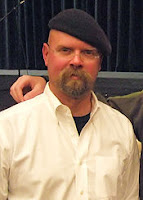
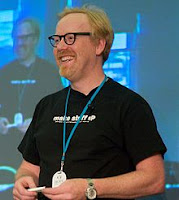
They were Jamie Hyneman and Adam Savage, stars of TV's Mythbusters, which is one of my favorite shows.
For those who don't know, Mythbusters takes on various "myths" which can include urban legends, rumors, adages, movie scenes, Internet videos, and the occasional bit of scientific error.
 For example, they have shown that you can teach an old dog new tricks, that two cars hitting each other at 50 mph does not result in the same amount of damage as one car hitting a wall at 100 mph, and that a bullet fired from a gun does hit the ground at the same time as one dropped from the height of the barrel. That last one proves a classic physics problem that has confounded many students as it seems wrong. They are, perhaps, the first to ever actually test this.
 Much of the show is show in, and around, San Francisco. It is not unusual to see the cast shopping at places near where I live. I have long figured that sooner or later I would probably see them in person.
They were Jamie Hyneman and Adam Savage, stars of TV's Mythbusters, which is one of my favorite shows.
For those who don't know, Mythbusters takes on various "myths" which can include urban legends, rumors, adages, movie scenes, Internet videos, and the occasional bit of scientific error.
 For example, they have shown that you can teach an old dog new tricks, that two cars hitting each other at 50 mph does not result in the same amount of damage as one car hitting a wall at 100 mph, and that a bullet fired from a gun does hit the ground at the same time as one dropped from the height of the barrel. That last one proves a classic physics problem that has confounded many students as it seems wrong. They are, perhaps, the first to ever actually test this.
Of course, I enjoy the show most when they are testing a scientific myth. Sometimes, it seems, that they just wish to blow things up. More than a few of their myths involve high explosives.
Of course, it is not at all surprising that I would see them in my neighborhood. The show is filmed right here in San Francisco, and is headquartered at Hyneman's M5 Industries, a special effects firm that used to provide support to commercials, movies, and TV shows. Now they primarily produce the show, and provide research and development for other companies.
 Much of the show is show in, and around, San Francisco. It is not unusual to see the cast shopping at places near where I live. I have long figured that sooner or later I would probably see them in person.
 Actually, I had seen Adam Savage at this year's Macworld. But it was fun to see the two of them together. Of course, since they were obviously having a business lunch (it appeared that it was some sort of meeting) I did not interrupt them. I would have loved to have had the chance to chat with them, but perhaps that opportunity will present itself in the future.
Granted, I fear that I would have either been afraid to speak, or would have quickly started asking for a job (it would be a Geek Girl's dream come true...) and it would have been embarrassing.
Saturday, April 24, 2010
History's Greatest Geeks, Part One
Geeks are not really all that new a thing. We have been around for a very long time, though we were not always called "geeks." In any case, history is full of those who fit would we would call "geekdom." I thought it might be interesting to consider a few...
The problem is not finding ones to name, but instead is having an abundance of riches. I know I will miss more than a few, so this list is by no means meant to be comprehensive, but instead to look at some of the great ones.

The problem is not finding ones to name, but instead is having an abundance of riches. I know I will miss more than a few, so this list is by no means meant to be comprehensive, but instead to look at some of the great ones.
Archimedes
Archimedes is a good one to start with. He was a Greek mathematician, physicist, engineer, inventor, and astronomer. His is credited with several discoveries, including his work in determining density, which arose from the request that he determine if a crown produced for the king was solid gold, or if the goldsmith had pilfered some, using silver to make up the difference.
He was taking a bath when he realized that his body was displacing an amount of water equivalent to his volume. Based on that, he could determine the volume of the crown, and therefore determine its density, which would be less if silver had been substituted for gold. He was so excited that he ran back home without remembering to dress, dashing through the streets yelling "eureka!"(literally, "I have found it!").
Galileo Galilei
Galileo Galilei was an Italian physicist, mathematician, astronomer, and philosopher. He discovered the first four moons of Jupiter, he was the father of modern physics, and in perhaps one of his geekiest moments, he gave us Galileo's Paradox. He observed that some numbers are perfect squares, that is, they are the square of an integer. But not all integers, are perfect squares and in fact, most are not. So, there must be more that are not perfect squares than that are. But, all integers are the square roots of a perfect sq are. Put in simple terms, there are as many perfect squares as there are whole numbers, even though most numbers are not perfect squares. This seems a contradiction, and Galileo concluded that more, less, and equal do not apply to infinite sets. But, in truth, as strange as it seems, some infinite sets are bigger than others.
He, along with Archimedes can thought of as the giants whose shoulders our next geek stood on...
He, along with Archimedes can thought of as the giants whose shoulders our next geek stood on...
Sir Isaac Newton
Newton was an English physicist, mathematician, astronomer, natural philosopher, alchemist, and theologian who was one of the most influential people in human history. He gave us the basis for classical mechanics including the three laws of motion:
First Law: An object at rest tends to stay at rest, or if it is in motion tends to stay in motion with the same speed and in the same direction unless acted upon by a sum of physical forces.Another major contribution of Newton was the development of calculus. He was the first to organize it into a specific field of mathematics, and also was responsible for some of the first applications. He was not the only one to contribute to its development, which brings us to our next figure from history...
Second Law: A body will accelerate with acceleration proportional to the force and inversely proportional to the mass.
Third Law: Every action has a reaction equal in magnitude and opposite in direction.
Gottfried Wilhelm Leibniz
Leibniz was a German mathematician who a invented calculus independently of Newton. In fact, they were involved in a bitter rivalry over which invented it first. Today, Leibniz's notation is the one used in calculus, though both contributed ideas to the subject, and as noted above, Newton was the first to organize it into an independent subject.
Of equal importance to geeks everywhere is Leibniz's documentation of the binary number system which he associate with the I Ching.
Leibniz also made contributions to the field of topology.
Leonhard Euler
Euler was a contemporary of Leibniz and the man who gave us the exponential function and logarithms. He also contributed to the field of complex numbers and gave us Euler's Identity, which is one of the most profound statements in all of mathematics.

This combines five of the most important constants in mathematics. The constant e is an interesting, number that shows up in many diverse places in mathematics and science. It is an irrational number(i.e. it can not be expressed by m/n where m and n are integers. Pi, the ratio of the diameter and circumfrunce of a circle, and is also irrational. And i, is the imaginary number that is the square root of -1. And of course, 1 and 0 are rather obvious in their importance.
Well, that is just a few of the numerous geeks from history. In future articles we will look at others, both living and dead. And both real, and fictional.
Subscribe to:
Posts (Atom)